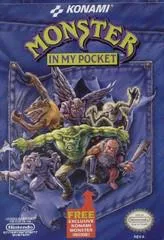
Monster in My Pocket Nintendo NES Console Price Guide & Value
Details Monster in My Pocket (Nintendo NES Console)
- Console
- Nintendo NES Console
- Genre
- Platformer
- Publisher
- Konami
- Release
- 2007
Market Value Monster in My Pocket
Price History Monster in My Pocket
Market Value & Price Range: Monster in My Pocket
How much is Monster in My Pocket worth on Nintendo NES Console?
The current price guide for this title is around $160.10 for a Complete (CIB) copy. For serious collectors, a brand new / sealed copy is valued at approximately $512.00. Graded copies (WATA/VGA) have been seen reaching $563.20 depending on the grade. This platformer title published by Konami remains a staple for any Nintendo NES Console library.
Where to buy Monster in My Pocket cheaper?
If you are looking where to buy Monster in My Pocket cheaper, the best live offer currently starts at €3.99 for a Gebraucht copy.
Buying Guide & Authenticity
Is Monster in My Pocket a rare game?
Monster in My Pocket on Nintendo NES Console is a highly sought-after title. Valued at $160.1 complete-in-box, it's a valuable addition to any collection. The game exists in both PAL (Europe) and NTSC (US/Japan) formats, giving collectors options based on their budget and hardware.
Description Monster in My Pocket
Pocket Monster is a NES platformer featuring Pikachu. It was also ported to the Game Boy Advance under the name Pok├®mon Gold Version. This is a simple platformer, in which the player controls Pikachu. Compared to many other NES games, the controls are inverted, which means that jumping is done by pressing B, and pressing A while moving in a direction makes Pikachu run, and A on its' own clears every enemy on the screen. It's also possible to stomp on enemies, similarly to Super Mario Bros.. Pikachu can take three hits before losing a life, with the number of hits left represented by a Pok├® Ball counter on the top left corner of the screen. There are a total of four worlds (Velbt, Woods, Tableland, and Motte) which are split into three levels each, as well as a single-screen boss battle at the end of each. This game has a debug mode enabled by default, allowing the player free movement while paused and to skip to the next level by pressing Select. In some places, the player can fall partway into the ground, although this doesn't have any implications. The music also glitches slightly at certain points. The background graphics are mostly ripped and slightly modified from Athena and Adventure Island II. Some of the enemies are also taken from various games, with some of them based on Pok├®mon. The sound engine was taken from Twin Bee, a game published and developed by Konami, and, while the game has a soundtrack of its' own, all the sound effects are still recognizably from Twin Bee - a setup similar to what Super Game and Gamtec used to have. The ending is Pikachu dancing with an "End" message at the top of the screen.